
Foundation settlement repair in St. Louis runs $3,800–$12,500 for most homes, with piers at $1,200–$3,000 each placed where an elevation survey shows the footing dropped. Shrink-swell clay drives most metro settlement; karst limestone under the south metro adds a second, weather-blind cause worth ruling out.
The two STL settlement stories, how brick reports them, and what repair involves.
Story one: the clay cycle
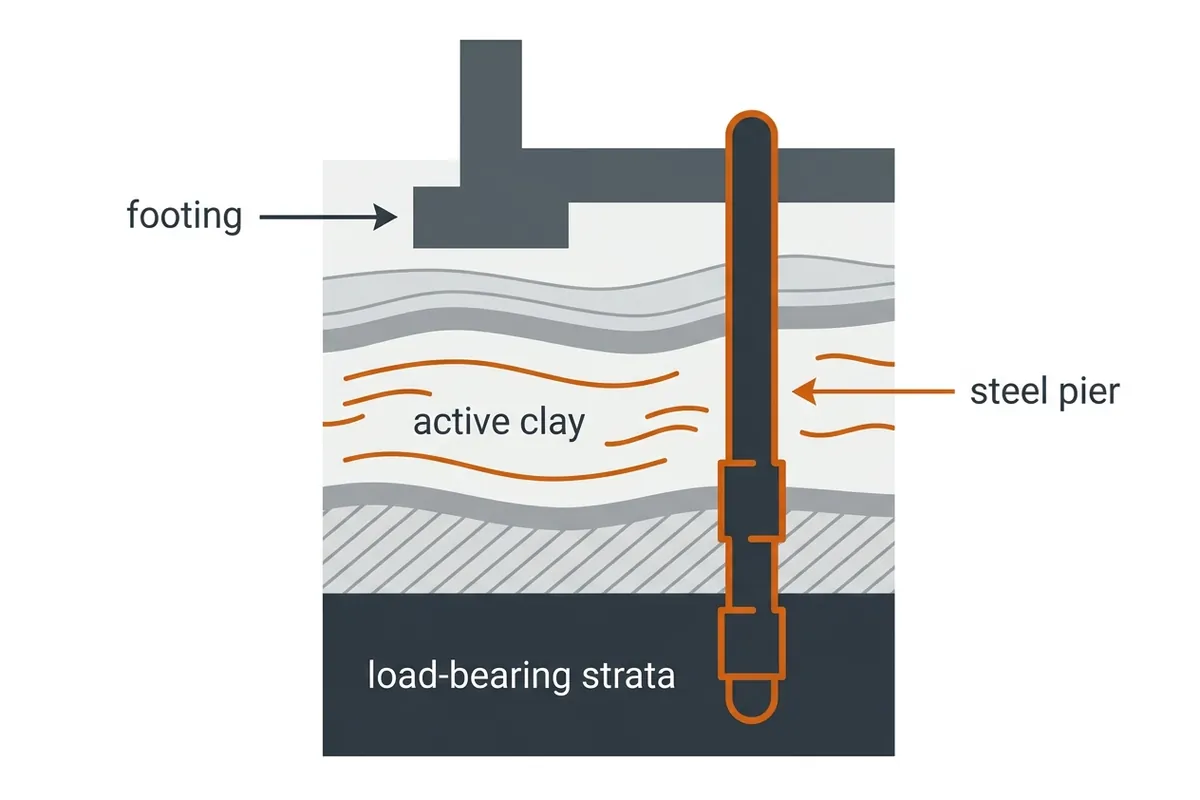
Most St. Louis settlement is the familiar Midwest mechanism running on local soil: shrink-swell clay over Missouri River alluvium loses moisture through dry summers, contracts, and lets the footing down; wet springs swell it back, but never fully — debris claims the gap and the foundation keeps the loss. Repeated freeze-thaw stacks a winter mechanism on top, working water into every crack the summer opened. The pattern is directional and seasonal: south and west exposures bake first, downspout corners cycle hardest, and the damage accumulates in steps that track the driest years.
Story two: the rock under the south metro
South St. Louis County sits over karst limestone — rock that groundwater dissolves along joints and bedding planes over geologic time. For a homeowner, the relevant version is rare but real: soils raveling into voids can settle a foundation on a schedule that has nothing to do with the weather. Movement that progresses steadily regardless of season, pairs with yard depressions, or concentrates oddly under one part of the house earns a harder look — sometimes including an independent engineer before any repair is designed. Most south-metro settlement is still ordinary clay work; the point of the survey is to know which case you have before buying either fix.
Reading the signs, clay vs karst
| Observation | Points toward clay | Points toward karst |
|---|---|---|
| Timing | Tracks seasons; worst after dry summers | Progresses regardless of weather |
| Location | One footing run, sunny or downspout side | Concentrated, sometimes mid-footprint |
| Yard | Normal | Depressions or soft zones can accompany |
| Pace | Steps, year over year | Can move faster once started |
| First move | Elevation survey, drainage check | Survey plus engineering review |
How the repair works
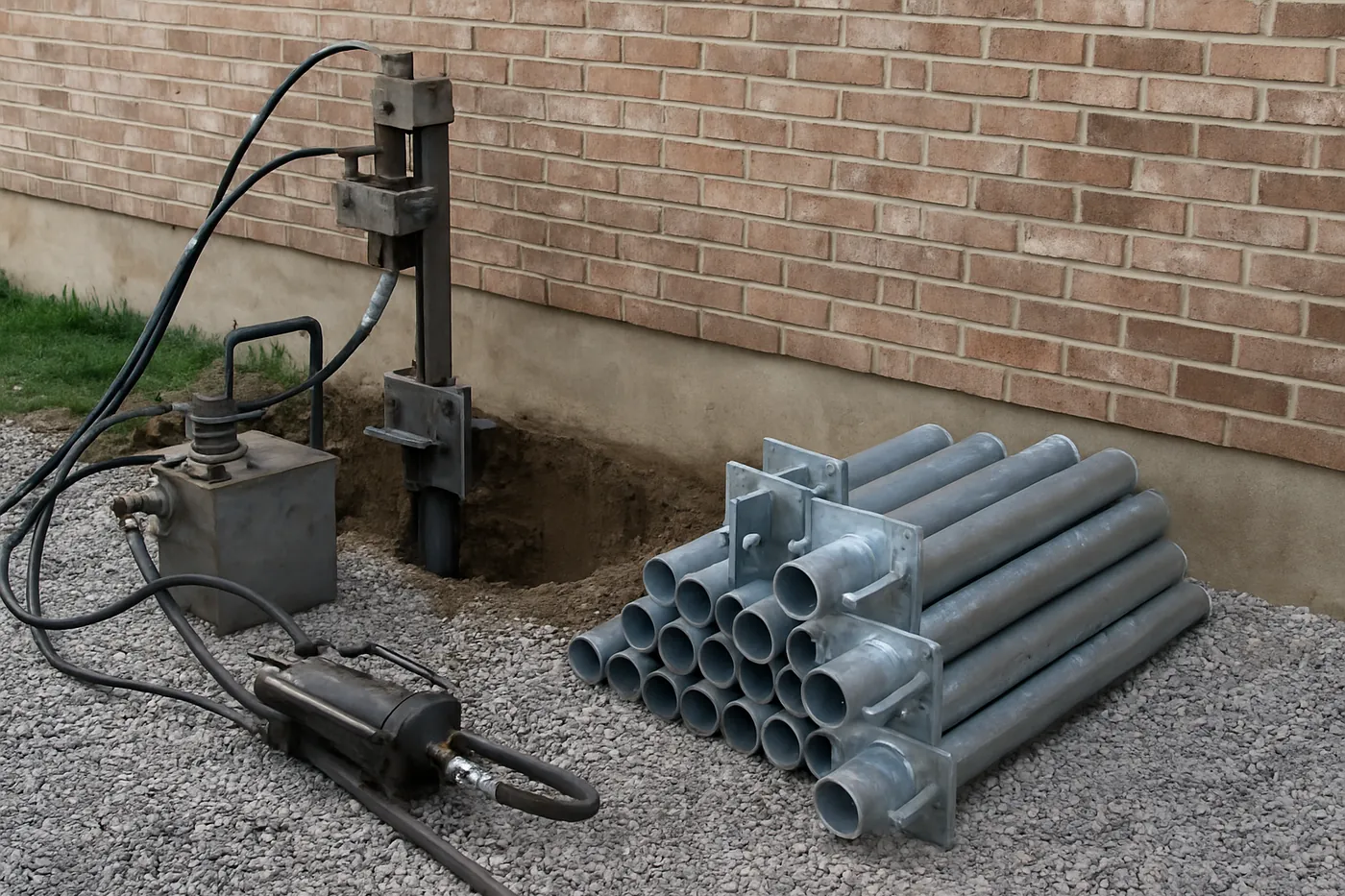
For clay settlement — the overwhelming majority — steel piers carry the footing below the active zone to bearing that ignores the seasons, each pier logged; mechanics live on the piering page and the steel choice on the helical-versus-push page. St. Louis adds one wrinkle: settlement and lateral wall pressure often share a basement, and lift staging has to respect a wall that’s already leaning. Cracked masonry gets injection and stitching after movement is resolved, and if drainage fed the cycle, water management belongs in the same scope. The cost guide itemizes all of it.
The first year after the piers
Piers stop the movement; they don’t erase its history. Give the house a full seasonal cycle before chasing cosmetics, including a winter of freeze-thaw working every joint it can reach. Hairline cracks breathe through that, so patch plaster and re-point brick after a complete year and you patch once — worth saying twice in a city of century brick, where tuckpointing is the expensive half of the cosmetic bill. Monitoring is free: a dated photo and a pencil line across each crack settles “did it move?” in seconds. South of the city, add a look at the yard after heavy rain: new depressions or water vanishing unusually fast are the surface signs of the karst void story, not the ordinary clay one.
Settlement questions, straight answers
How do I know if it's clay settlement or something under the rock?
Pattern and pace. Clay settlement tracks the seasons — worst after dry summers, partially recovering wet springs — and maps to one footing run. Karst-related movement in the south metro doesn't care about weather: it's progressive, sometimes fast, and can pair with depressions in the yard. The elevation survey plus the movement's timeline separates them, and the second kind changes who needs to be involved.
What does settlement look like in a century brick house?
Brick reports in stair-steps. St. Louis city and the inner suburbs are full of masonry that telegraphs movement through mortar joints — cracks stepping up from a corner, arches flattening over openings, a party wall shedding plaster. Brick is brittle and honest: it cracks early, which is unnerving and useful. Measured early, the repair is smaller.
Do sticking doors in August mean my foundation is failing?
Not by themselves. Full-basement houses here breathe with the clay: frames rack slightly in dry stretches and ease back when moisture returns. The signal worth acting on is movement that accumulates — a door that sticks a little more each year, cracks that reopen wider after each cycle. That trend line, not one bad August, is what the survey documents.
Can drainage fixes stop settlement without piers?
Early and small, sometimes — steady the moisture, steady the clay. A downspout dumping at a corner is a classic STL settlement starter, and correcting it costs a fraction of steel. But once elevations show a footing has genuinely dropped, drainage protects the repair rather than replacing it: the lifting is pier work.
What does settlement repair cost in St. Louis?
Most structural repairs run $3,800 to $12,500, with piers at $1,200 to $3,000 each placed where the survey shows loss. Brick-heavy homes sometimes need more careful lift staging than frame houses, which affects labor more than pier count. Every scope prices each pier location in writing before work starts.
Get a free St. Louis foundation evaluation
Tell us what the house is doing — cracks, bowing, sticking doors, sloping floors — and we'll schedule an evaluation with photos and crack measurements. We reply the same business day.