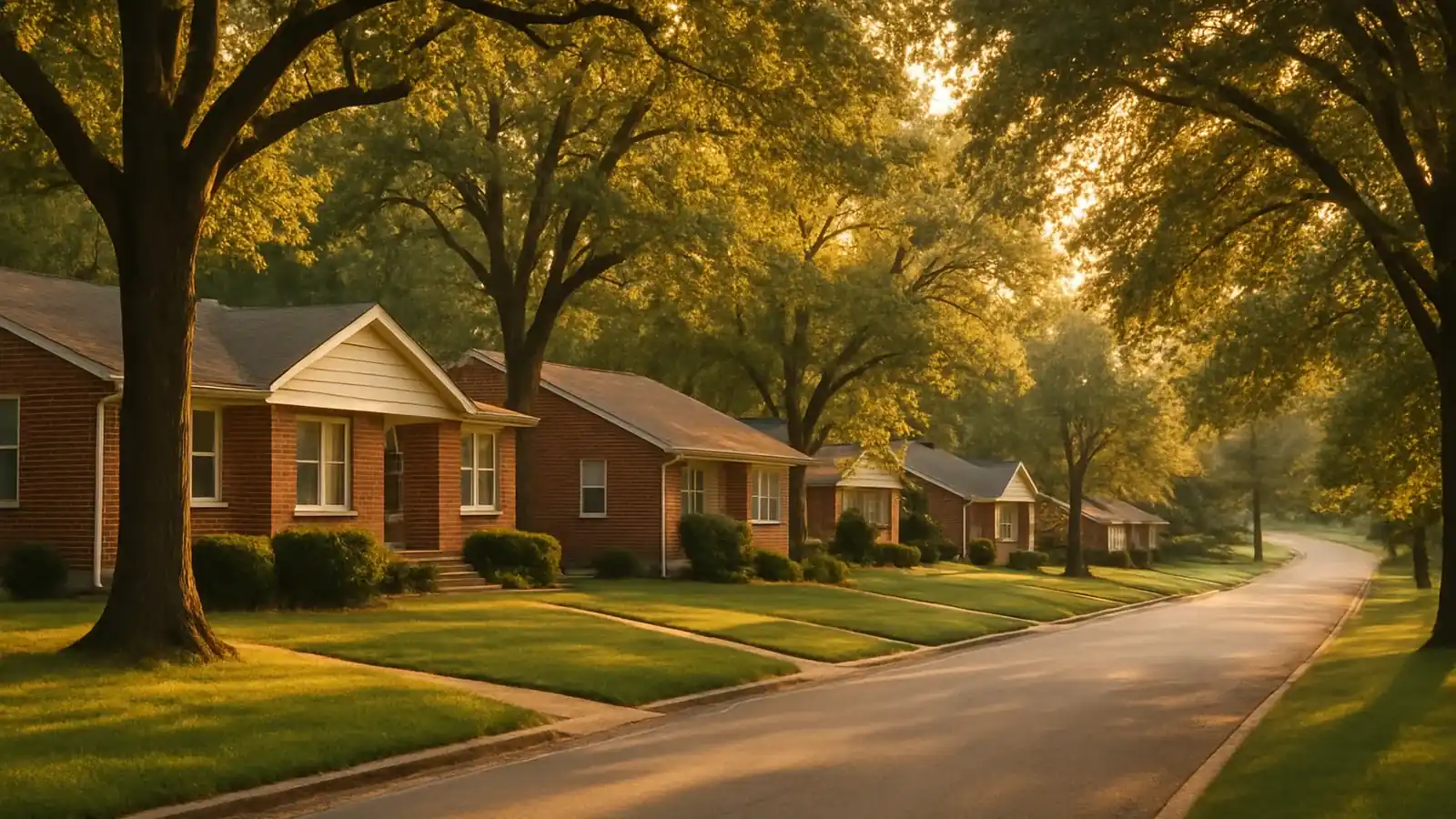
St. Louis Foundation Co. covers the metro from the city out through Kirkwood, Webster Groves, Florissant, Chesterfield, Ballwin, Oakville, Affton, Maryland Heights, and across the river to St. Charles: measured evaluations everywhere on the list.
Choose your community
KirkwoodWebster GrovesFlorissantChesterfieldBallwinOakvilleAfftonMaryland HeightsSt. Charles
Every town covered, and what changes there
Each of these has its own page, because the ground and the housing stock are not the same across the region. The short version:
Kirkwood: Old trees, old footings, active clay
Kirkwood's charm is its age: Queen Annes near the 1893 train station, 1920s bungalows off Adams, midcentury ranches toward Meramec Highlands. Read what that means for a Kirkwood property.
Webster Groves: The Victorian-basement problem
Old Webster and the streets around the university hold some of the metro's loveliest pre-1930 housing, and its most improvised foundations. Read what that means for a Webster Groves property.
Florissant: The 1950s-60s ranch, seventy years in
Florissant boomed after the war: block after block of brick-veneer ranches and split-levels built fast for young families. Read what that means for a Florissant property.
Chesterfield: Hill houses and valley ground
The uplands (the 1980s-2000s subdivisions off Clarkson and Wild Horse Creek) sit on classic metro shrink-swell clay: newer engineered foundations, but bigger footprints and finished basements with more to lose when walls take pressure. Read what that means for a Chesterfield property.
Ballwin: Rolling hills, tilted lots
Ballwin's 1960s-80s subdivisions ride real topography: streets that climb, back yards that fall away toward Grand Glaize Creek and its feeders. Read what that means for a Ballwin property.
Oakville: What karst means under a subdivision
Oakville and the Mississippi-bluff side of south county sit over soluble limestone: karst terrain, the same geology that pockets this corner of the metro with mapped sinkholes and losing streams. Read what that means for an Oakville property.
Affton: Eighty-year-old brick, mid-test
Affton's blocks of 1940s-50s brick bungalows and story-and-a-halfs are the metro's workhorse housing: solid, unpretentious, and now deep into the decades where clay cycling shows. Read what that means for an Affton property.
Maryland Heights: Living with Creve Coeur Creek
Maryland Heights drapes over the terrain where the upland clay steps down toward the Missouri River: Creve Coeur Creek and its branches cut through, and the Riverport flats beyond run to true bottomland. Read what that means for a Maryland Heights property.
St. Charles: From 1820s Main Street to 2020s cul-de-sacs
Charles holds the metro's full architectural spread: Federal-era brick near historic Main Street standing on rubble and timber sills, streetcar-era neighborhoods up the hill, and the vast newer subdivisions running toward Cottleville. Read what that means for a St. Charles property.
Same clay, different chapters
Every page above is written for its own ground: Kirkwood's century homes under century oaks, Oakville's karst arithmetic, Ballwin's cut-and-fill hillsides, St. Charles' river-bottom alluvium. The metro shares one soil story, but your street is a specific chapter, and the evaluation reads that chapter, not the regional average. Between towns or outside the list? Ask, including whether travel is charged.

Three soil regimes, ten communities
The service area splits into three kinds of ground, and knowing which one you're on predicts what your evaluation will find. The upland clay communities (Kirkwood, Webster Groves, Affton, Florissant, Maryland Heights) sit on the metro's signature shrink-swell clay: wet-season lateral pressure on basement walls, dry-August settlement at footings, the full classic cycle. The valley and river-bottom communities: Chesterfield's valley floor and St. Charles across the Missouri: add deep alluvial soils that move with moisture far below a standard footing, which changes how piers are specified. And Oakville anchors the karst south county, where limestone below the clay moves water in ways surface grading can't explain, and where sudden movement earns a harder look before anyone talks price.
Ballwin is its own case: post-war hillside development means cut-and-fill lots, and fill settles on its own schedule regardless of what the native clay is doing. The evaluation distinguishes the two: the fix for fill settlement is not the fix for clay settlement, and a scope that doesn't say which one you have isn't finished.
What your house's era predicts
Age is the other axis. The pre-war brick of Webster Groves and Kirkwood (some of the metro's best-built houses) sits on unreinforced foundations that have survived a century of clay cycles but telegraph every new movement through the masonry; repairs there are as much about preserving brick as stabilizing footings. The mid-century ranches of Affton, Florissant, and Oakville were built fast in the '50s and '60s with shallow-by-modern-code footings on active clay: the metro's highest-volume repair profile: bowing block walls and corner settlement. The newer two-stories of Chesterfield, Ballwin, and St. Charles carry modern code depths but heavier loads, on the metro's trickiest soils. Each town page above reads its own housing stock honestly. That's the point of having ten of them.
What it means when a town is listed here
It means the first visit is available at your address on the same terms as in St. Louis. A good evaluation there includes the same floor survey and crack measurements and a written scope afterwards. If a job is far enough out that travel is material, ask for that number as its own line before you agree to anything.
Foundation work is scheduled, not urgent, so ask whether an outlying address changes the timing.
These 9 communities are the ones these guides cover in detail, with the ground described before anyone arrives. That is the honest boundary: not a radius drawn on a map, but the places documented well enough to recognise what a survey is showing.
Coverage questions
Is there an extra charge to come out to the outlying towns?
If travel is charged, ask for it as its own line before agreeing to anything, rather than folded into the price of the work, because a scope you cannot read is a scope you cannot compare against anyone else's.
My address is not on the list. Will a specialist still come?
Usually, and it is worth asking. The list is where these guides describe the ground in advance, not a hard boundary. Somewhere between two of these towns is almost always a yes.
Is the first visit free, everywhere on this list?
Many local specialists don't charge for the first visit, but it depends on the company. Ask when the specialist calls, before they come out. The terms are the same in Kirkwood as in St. Louis. Ask to keep the laser floor survey, the crack measurements, and the written findings whether or not you go ahead.
Why does the price differ between towns for the same job?
Because the ground does. Each town page above explains what changes locally, and the quote follows what the visit measures at your specific address rather than an average for the region.
Get a St. Louis foundation evaluation
Tell us what the house is doing (cracks, bowing, sticking doors, sloping floors) so the evaluation starts from what you have seen. A specialist who serves the St. Louis area will call you back.